DR. ATABAK KH
Cloud Platform Modernization Architect specializing in transforming legacy systems into reliable, observable, and cost-efficient Cloud platforms.
Certified: Google Professional Cloud Architect, AWS Solutions Architect, MapR Cluster Administrator
The Technical Leader's Trap: Solving Everything Yourself
Published on 05 November 2020.
I became a lead because I could unblock anything under my responsibility. Then I became the bottleneck for everything while the team waited.
Context: In 2020, many senior engineers were working remotely for the first time while teams depended heavily on chat, calls, and a few people who held critical knowledge. I was in an awkward middle: officially a lead, but still the default solver for migrations, pipelines, and incidents. The organization called it technical leadership. It often felt like hero mode with a new title.
This trap is common. Working harder does not fix it.
Signs I was in it
Slack DMs were my workflow system. I was in every architecture review “just in case”. Tickets stalled until I commented. I debugged at night; the team waited by day. I told myself delegation takes longer - for the 400th time. Burnout felt like responsibility.
If the team cannot ship when you are on vacation, you are not leading. You are load-bearing in the wrong place.
Why orgs push you there
I had rewarded the behavior: every fast firefight taught people to route the next fire to me. Success metrics were vague (“keep the platform running”), ownership was never distributed, and managers confused senior individual-contributor output with lead output. Honestly, technical problems were clearer than people problems. That preference had a career cost.
Solver vs leader
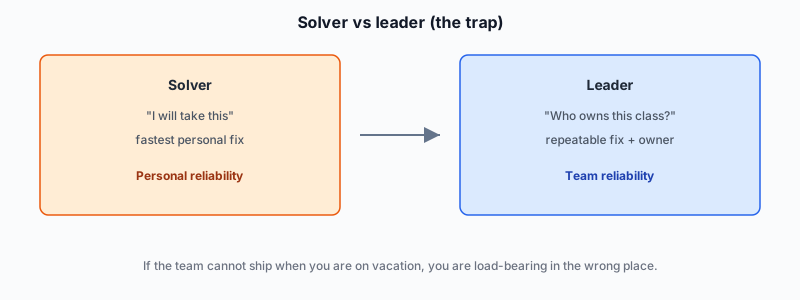
| Solver | Leader |
|---|---|
| Fastest fix wins | Repeatable fix wins |
| “I’ll take this” | “Who owns this class of problem?” |
| Answer the question | Leave a way for others to answer next time |
| Be right in the meeting | Leave with a decider and an owner |
| Depth on everything | Depth on risks; breadth on ownership |
| Personal reliability | Team reliability |
Output shifts from tasks completed to capacity created.
What I did over about 30 days
| Week | What I did | What it revealed |
|---|---|---|
| 1 | Tracked every interrupt for five days | Most “decisions” were missing standards |
| 2 | Published 3 docs and linked instead of DM replies | Recurring answers were undocumented |
| 3 | Delegated with context, constraint, checkpoint, authority | “Look at this when you have time” was not delegation |
| 4 | Redesigned the calendar for systemic work | Interrupts were signals about missing systems |
Week 1. Buckets: decision, information, execution, support. Most “decisions” were missing standards.
Week 2. Replaced three recurring answers with docs - runbook section, architecture checklist, how we choose freshness. Linked instead of replied.
Week 3. Delegated with context, constraint, checkpoint, authority:
You own the reconciliation fix. Budget 3 days. Must pass finance parity. Ping me only if the variance model changes.
Not: “look at this when you have time.”
Week 4. Redesigned the calendar for systemic work: ownership gaps, SLOs, hiring, and cross-team agreements. I started treating interrupts as signals about missing systems.
What I needed from my manager
Cover for the short velocity dip while I delegated. Back me when the team pushes back (“ask the runbook first”). Measure lead success differently: team throughput, repeat incidents, bus factor. Staff the platform - one lead cannot replace missing headcount forever.
If the manager only celebrates personal saves, they are incentivizing the trap.
Hard conversations
With manager: I am the bottleneck on X. I need to transfer Y and Z this quarter. Here is the risk if we do not.
With team: I will not be first responder on this class of issue anymore. Here is the escalation path.
With stakeholders: I can join this review if we assign an owner. Otherwise we are repeating last month.
Uncomfortable - because you were promoted for the opposite behavior.
Closing
The trap is solving everything yourself until the team and platform depend on you personally. What helped: standards, delegation with authority, measuring team capacity, accepting that the job is to make yourself less necessary for daily execution - not more heroic.
This is a personal blog. The views, thoughts, and opinions expressed here are my own and do not represent, reflect, or constitute the views, policies, or positions of any employer, university, client, or organization I am associated with or have been associated with.