DR. ATABAK KH
Cloud Platform Modernization Architect specializing in transforming legacy systems into reliable, observable, and cost-efficient Cloud platforms.
Certified: Google Professional Cloud Architect, AWS Solutions Architect, MapR Cluster Administrator
Why AI Projects Fail Between Prototype and Production
Published on 07 May 2026.
The demo worked. The pilot dashboard looked green. Then production asked for SLAs, cost predictability, audit trails, and the same answer on Tuesday that you got on Monday.
Context: By spring 2026, the industry story was pilots to production. The graveyard I kept seeing was full of prototypes that never crossed the gap - not because the model was wrong, but because the operating system around the model was never built.
The prototype trap
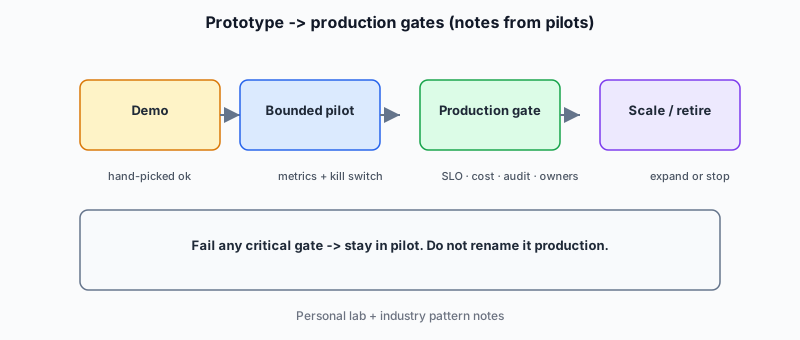
Prototypes optimize for visible magic: hand-picked examples, clean indexes, tolerant users, no formal SLO or cost ceiling, manual cleanup when outputs look bad.
Production optimizes for reliability under variance: messy data, bad inputs, regulated and revenue-critical decisions, FinOps and audit, users who trust confident wrong answers.
Skills overlap partially. Infrastructure and discipline overlap less than teams expect.
Seven failure modes in the gap
1. No production definition of “good enough”. Pilot: “users liked it.” Production needs measured time saved, error/override rate, cost per task, p95 latency - with kill criteria. Without metrics you cannot tell if v2 is better.
2. Freshness and scope drift. Prototype index built once. Production tables and docs change hourly. Answers go wrong silently. Freshness SLAs, re-index pipelines, as_of in context.
3. Cost curves that do not scale. Demo: 50 queries/day. Production: 50,000 with retrieval, re-ranking, multi-step agents. Cost per successful outcome, budgets, caching, right-time tiers, route by complexity.
4. Missing fallbacks. Model or retrieval fails -> errors or hallucinations. Deterministic fallbacks, kill switches, degraded UX - tested, not improvised.
5. Security added late. Broad access “to move fast”. Agents compound exposure. Least privilege, retrieval boundaries, approval tiers.
6. No ownership after handoff. Data science built it; ops inherits it; data platform was never in the room. Named owners for model, inputs, runtime.
7. Change management ignored. Users do not know when to trust, when to override, what changed in v2. Release notes, confidence cues, feedback loops.
Gate I would use before go-live
| Gate | Requirement |
|---|---|
| Data | Contracts + freshness SLAs on inputs |
| Quality | Golden-set eval; regression on prompt/model change |
| Reliability | p95 within tier; fallback tested |
| Cost | Projected monthly cost at expected volume; ceilings |
| Security | Access review; audit logs; residency |
| Operations | Runbook, on-call owner, kill switch drill |
| Governance | Risk tier; approvals for high-risk actions |
Fail a critical row -> stay in bounded pilot. Do not call it production.
Pattern that worked
From personal lab copilot experiments and common enterprise patterns:
- One narrow workflow with clear baseline metrics
- Right-time freshness - not fake real-time
- Strict success gates - retire what does not pass
- Kill switch - prove reversibility
- Platform fixes in parallel - not “after AI succeeds”
Production AI is systems integration. The model is one component.
After demo applause
Words I used:
The demo proved the workflow is worth testing. Production needs the same gates as customer-facing services: data ownership, cost ceiling, fallback, audit. Here is the 8-week path and what we will not do until gates pass.
Red flags: warehouse-wide access for the agent; no business owner for definitions; success metric is “delight” with no baseline; platform team learns about the project from security review.
What helped organizationally: single intake with risk tiers; platform + product + security sign-off for production; explicit retire list so failed pilots stop and budget returns to the platform.
Leaders who only celebrate demos inherit incidents. Leaders who gate honestly build durable capability.
Closing
AI projects fail between prototype and production when teams ship demos into operational reality without SLOs, cost models, fallbacks, governance, and ownership. Explicit production gates closed that gap - not another hackathon.
This is a personal blog. The views, thoughts, and opinions expressed here are my own and do not represent, reflect, or constitute the views, policies, or positions of any employer, university, client, or organization I am associated with or have been associated with.