DR. ATABAK KH
Cloud Platform Modernization Architect specializing in transforming legacy systems into reliable, observable, and cost-efficient Cloud platforms.
Certified: Google Professional Cloud Architect, AWS Solutions Architect, MapR Cluster Administrator
From Technical Expert to Technical Leader: What Actually Changes
Published on 20 March 2026.
The promotion did not come with a new toolchain. It came with ambiguity, stakeholders who disagree, and problems that do not fit in an IDE.
Context: In 2026 many orgs created staff engineer and technical lead paths without clear definitions. When I moved into those roles the question was always: what actually changes on Monday? Notes from platform, data, and cloud leadership - not generic management theory.
What does not change
You still need technical judgment. You still read code, query plans, incident timelines. Credibility comes from understanding the work. If you stop being technically credible, good engineers route around you.
What actually changed for me
Calendar became the product. Experts optimize focus for deep work. Leaders optimize throughput: who is blocked, which decision is stuck, which risk is invisible upstairs, which standard would kill ten Slack threads. If 80% of the calendar is meetings, they need to produce owners, dates, and written decisions - not only “alignment”.
Communication is a deliverable. Expert: “Partition pruning fails on this query.” Leader: “Finance dashboard may breach SLA; owner is data-platform; fix or workaround by Thursday; impact if numbers are wrong.” Same fact. Different accountability.
Team graph, not call graph. Success is no longer “I shipped the fix”. It is: runbook used without you; junior owns a production change with review; two teams stop arguing because a contract exists; incident repeat rate drops.
Durable over perfect. Can we operate this at 3am? Can another team extend it without calling us? Can we reverse it? Does ownership survive my next vacation?
Translate both ways. Upward: risk into cost, revenue, compliance, timeline. Downward: business pressure into prioritized constraints, not vague urgency. Failure mode is absorbing anxiety from both sides until you burn out. Pass clarity, not stress.
Skills I had to practice on purpose
Written decisions (one-page ADRs). Facilitation with a named decider. Delegation with owner + checkpoint + authority. Hiring and mentoring so someone else can take your old tasks. Saying no with trade-offs written down. Enough financial literacy to talk cost-to-serve and ROI of platform work.
No MBA required. Reps required.
Mistakes in the first year
Still competing with the team on coding speed. Avoiding ownership and priority fights. Over-engineering standards nobody reads - one useful runbook beats a 40-page manifesto. Under-communicating to executives (surprises destroy trust faster than bad news told early). Identity crisis: “Am I still an engineer?” Yes - with a broader definition of impact.
Weekly rhythm that helped
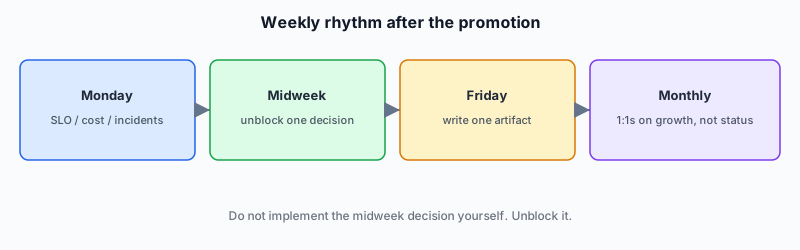
| When | Do this | Do not do this |
|---|---|---|
| Monday | Review SLO, cost, incident trends | Ignore silent quality drift |
| Midweek | Unblock one cross-team decision | Implement it yourself |
| Friday | Write one artifact (ADR, runbook, contract) | Leave decisions only in Slack |
| Monthly | 1:1s on growth | Status meetings that belong in tools |
Questions for your manager
What outcomes define success for me in six months? Which decisions are mine vs shared? What should I stop doing that I did as an IC? How will you measure team health, not only dates?
If they cannot answer, negotiate clarity before accepting infinite responsibility.
Closing
Expert -> technical leader means primary output becomes clarity, ownership, standards, and leverage - not personal execution speed. Still engineering. The interface is human and organizational as much as technical.
This is a personal blog. The views, thoughts, and opinions expressed here are my own and do not represent, reflect, or constitute the views, policies, or positions of any employer, university, client, or organization I am associated with or have been associated with.