DR. ATABAK KH
Cloud Platform Modernization Architect specializing in transforming legacy systems into reliable, observable, and cost-efficient Cloud platforms.
Certified: Google Professional Cloud Architect, AWS Solutions Architect, MapR Cluster Administrator
Cloud Cost Is an Architecture Problem, Not a Finance Problem
Published on 20 March 2021.
Finance sees the invoice. Architecture creates it. The durable cost improvements I saw did not come from better spreadsheets - they came from changing how data was partitioned, scheduled, and consumed.
Context: By early 2021, accelerated cloud adoption had left many organizations with bills that finance could not explain by product or domain. Cost-management tools improved visibility, but visibility alone did not create sustainable savings. Pipelines, warehouses, retention policies, and scaling behavior still had to change.
Why finance-only FinOps stalls
Monthly reviews can flag anomalies, allocate spend roughly, and enforce budgets after the fact. They cannot fix a nightly job that scans 200 TB because nobody added a partition filter. They cannot merge three duplicate pipelines owned by three teams. They cannot decide that a daily decision does not need an hourly job.
Those are architecture decisions with a cost attached.
Where the money usually goes in data platforms
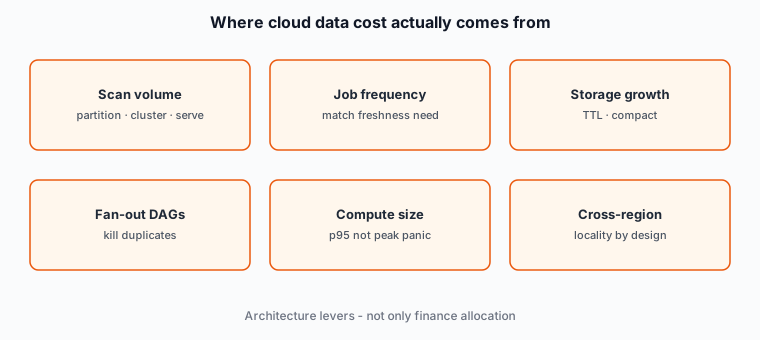
| Driver | Lever that actually moved the number |
|---|---|
| Warehouse scan volume | Partitioning, clustering, serving tables |
| Job frequency | Match schedule to how fresh the decision needs to be |
| Storage growth | Retention, compaction, lifecycle |
| Orchestration fan-out | Fewer duplicate extracts, cleaner DAGs |
| Over-provisioned compute | Right-size; scale on p95, not on peak panic |
| Egress / cross-region | Locality by design |
Practical example - cap a BigQuery job at 10 GB from the command line:
bq query \
  --use_legacy_sql=false \
  --maximum_bytes_billed=10000000000 \
  --parameter='start:DATE:2021-03-01' \
  --parameter='end:DATE:2021-03-31' \
  'SELECT *
   FROM `curated.fact_events`
   WHERE event_date BETWEEN @start AND @end'
What I started putting into architecture reviews
- Expected bytes scanned per run - estimate before deployment
- Cost-to-serve per domain - attribute pipelines to a product or business unit
- Freshness versus schedule - hourly processing for a daily decision is waste
- Materialize versus recompute - calculate repeated heavy joins once
- Decommission plan - parallel legacy and cloud systems double spend
Engineers should see cost estimates the way they see latency estimates.
Guardrails that stuck
Architecture alone is not enough. We also needed:
- Per-query byte caps on production service accounts
- Budget alerts at 50%, 90%, and 100%, with domain tags
- Terraform limits on expensive resource types
- Reservations for steady baseline after right-sizing
Guardrails stop the bleeding. Redesign stops the wound.
Habits that helped without turning into blame
Show teams the marginal cost of a new pipeline. Celebrate deletion and retention wins, not only launches. Pair FinOps practitioners with platform architects each month. Put cost next to freshness SLOs on the same dashboards.
Finance owns the budget. Engineering owns the shape of the spend.
Closing
Cloud cost is an architecture problem because scan patterns, schedules, layers, and retention are design choices - not billing surprises. Architecture has to move first. FinOps keeps it honest.
This is a personal blog. The views, thoughts, and opinions expressed here are my own and do not represent, reflect, or constitute the views, policies, or positions of any employer, university, client, or organization I am associated with or have been associated with.