DR. ATABAK KH
Cloud Platform Modernization Architect specializing in transforming legacy systems into reliable, observable, and cost-efficient Cloud platforms.
Certified: Google Professional Cloud Architect, AWS Solutions Architect, MapR Cluster Administrator
A Platform Without Ownership Becomes a Graveyard
Published on 18 June 2026.
Pipelines still ran. Dashboards still loaded. Nobody deleted anything, fixed definitions, or admitted the mart nobody used cost thousands a month. That was a graveyard - not a platform.
Context: By mid-2026 many enterprises had years of cloud data investment and dozens of AI experiments - and the same failure mode kept showing up: no clear ownership for data products. I have seen this as much as a leadership problem as an architecture problem.
How graveyards form
Migration ends; SI leaves; runbooks thin; bus factor is one. Hero engineer moves teams; knowledge walks out. “Shared responsibility” - everyone assumes someone else owns freshness. New initiatives layer on: shadow marts, duplicate pipelines, more indexes. Cost grows quietly; nobody deletes because nobody will sign the deletion.
The platform looks alive. Accountability is dead.
Symptoms
Incidents start with “who owns this table?” Same metric built three ways with three numbers. Pipelines green while quality checks failed for weeks. Access requests go to a generic mailing list. Decommission dies in committee. AI teams rebuild customer 360 for every project.
Ownership is capacity to change, not blame
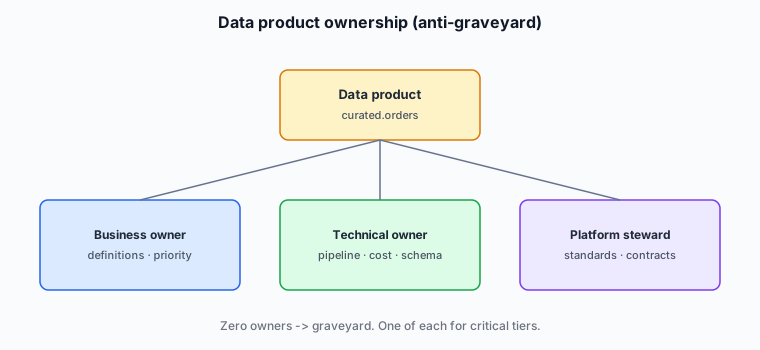
| Role | Accountable for |
|---|---|
| Business owner | Definitions, priority, acceptable delay, telling consumers |
| Technical owner | Pipeline health, cost, schema evolution, runbooks |
| Platform steward | Standards, contracts registry, shared tooling, escalation |
One person can wear multiple hats in a small team. Zero people wearing them is the graveyard pattern.
Contract fragment I pushed for on critical tables:
dataset: curated.orders
owners:
  business: order-management
  technical: data-platform-core
consumers:
  - bi_revenue_dashboard
  - support_copilot   # automated consumer = ownership risk
decommission_candidate: false
monthly_cost_eur_est: 4200
What I push for in the leadership seat
Name owners before publishing datasets. No owner -> not production for critical tiers.
Measure cost and usage per domain. Unused assets with cost are decommission candidates - with owner approval.
Treat decommissioning as a success metric. Reward turning things off after cutover.
On-call follows the data product for critical paths - same seriousness as customer-facing APIs.
When agents depend on a table, ownership includes that automated consumer risk. Put it in the contract.
Cleaning a graveyard without stopping the business
Month 1: Inventory - datasets, last access, monthly cost, named owner or NONE.
Month 2: Stabilize ownership on the top revenue/compliance products first.
Month 3: Merge duplicate marts; delete unused staging with sign-off; document lineage.
Ongoing: No new production without owner fields. Platform gates the deploy.
Unglamorous. Also what separates platforms that scale AI from platforms that accumulate debt.
Link to the technical leader trap
Senior engineers often become the implicit owner of everything. Feels helpful. Creates a graveyard in one person’s head.
Leadership means refusing to be the permanent owner, making ownership visible and rewarded, escalating unowned critical assets, building standards so ownership is lighter - not heavier. Solving everything yourself until you are the bottleneck is the other side of the same problem.
Closing
A platform without ownership becomes a graveyard: running pipelines, stale trust, rising cost, nobody accountable for change. Naming owners, measuring usage and cost, decommissioning on purpose, treating data products like production services - that is what helped.
This is a personal blog. The views, thoughts, and opinions expressed here are my own and do not represent, reflect, or constitute the views, policies, or positions of any employer, university, client, or organization I am associated with or have been associated with.